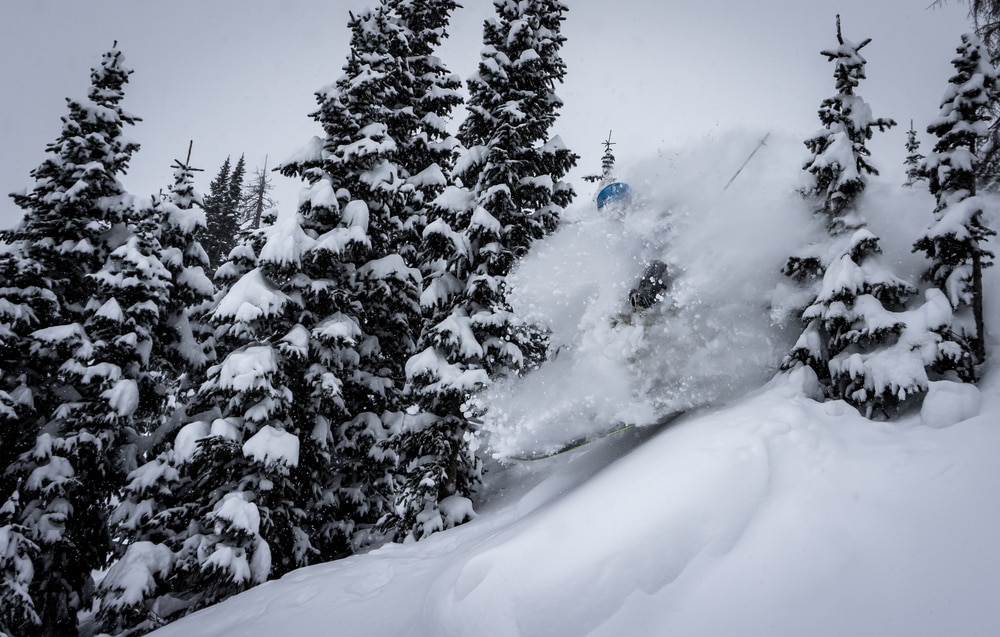
Meet our second female pro skier!
In case you didn’t attend a premiere of Teton Gravity Research’s Magic Hour this fall—meet Amy David.
Amy lives in Sun Valley, Idaho. She skis professionally for Icelantic, among other sponsors, and entered the TGR film scene last winter. She also snowmobiles, teaches avalanche education for AIARE, works with the Sawtooth Avalanche Center, and is halfway through a ski guide certification process with the American Mountain Guides Association (AMGA).
We caught up with Amy to talk skiing, career moves, gaper day outfits, and more.

Where did you grow up skiing?
In Pinedale, Wyoming, about an hour and a half south of Jackson. I was born in Jackson and lived in a remote ranch with my parents, but then I’ve lived most of my life in Pinedale. We lived farther out of town at the base of the Winds, and I grew up with livestock, having to do chores every morning. You learn to love the cold. The ski resort I skied at most of the time, White Pine, is in the foothills.
Did skiing come easy to you? Were you a prodigy?
I wouldn’t say I was a prodigy. I wish. Skiing was the thing I loved most as a kid. My parents taught me to ski about the same time I learned to walk, so I’ve been doing it for a long time. I grew up racing as part of the community ski club at White Pine and raced all through high school. We’d go train at Snow King in Jackson.
In high school, I got into freestyle on the aerial jumps in Pinedale. Learned backflips and what not. I did a few aerials comps in high school on top of the racing. Somehow I qualified for the US freestyle championships—but it’s not that impressive. All I did was a single backflip. There just weren’t many people doing it. But it sounds cool! I also got to see the US aerials team doing their thing, and that’s when I realized I’m not a gymnast. I realized I was more interested in big mountain skiing.
You do so much. Did you want to be a pro skier first? Guide? Instructor?
The love of skiing has always driven everything. I wanted to be a pro skier since high school. I’ve always thought that if I can keep to simplicity, just a love of skiing, things will pan out. Being in films was my number one goal, but I’ve had a roundabout way of getting there. I blew my ACL twice and had several other big injuries when I was getting started.
So I got my ‘in’ doing marketing and PR in the ski industry, shooting photos and producing content. I got my first job as a skier in 2013: a McDonalds commercial. I was a background skier and probably not even in focus. But it was my first time getting paid for skiing. After that I would work as a ‘ski action model’ for lots of different ski brands before I got my first sponsored athlete contract.
If you want a sustainable career, you need more value than just one skill set. The guiding stuff came from my outdoor education degree. I started working as a backpacking guide in the summers and have done that for 10 years. I was in the mountains all the time, so I realized it would be cool to also be a ski guide. The goal has always been to spend more time in the mountains. The instructing has come along with that.

Who’s someone who has had a dramatic influence on your skiing?
My parents and grandparents. They taught me to ski, and they’ve always supported my vision for a ski career. As far as becoming a pro skier and learning to navigate the ski industry, Julian Carr has been so helpful. He’s always been a mentor for me.
For ski guiding, Margaret Wheeler has been a mentor for me. There are different characters for different types of ski pursuits.
How’d you get into snowmobiling?
When I started competing in big mountain events in 2016, I got in a bad crash. Broke my pelvis and had a bunch of other bad injuries. I made myself come back to comps the next year after recovering. The competition venue in Revelstoke was hardpack moguls, and I remember looking across the valley and realizing I wanted to be in the backcountry and didn’t really want to part of the comp scene anymore. When I got home to Stanley, Idaho, I skied a lot of the big lines in the Sawtooth area that require a snowmobile to access. The next year I bought my own sled, learned how to ride, and have been hooked ever since.
What are your career goals? What are you working on next?
It’s a combination of things. I want to continue filming with TGR. I like working with that level of a production company. With that, I’m doing both snowmobile access skiing in a freeride style, but at the same time I’m trying to develop my skills in the ski mountaineering realm, going on more remote expeditions and trips. I also plan to continue organizing women-specific retreats and learning opportunities.
For the far off future, I want to have more intention in some of my ski trips. Maybe I hook up with scientists where I could go collect snow samples in all these places, for example. It would still mostly be about fun and skiing as much as I can, but then I’d also have some intention to it.
Ok, time for some favorites. Describe your dream ski day.
Well. You wake up before sunrise in a yurt high in the mountains. You open the door and it’s going to be a bluebird pow day, and you drink coffee with your friends. Snow stability is a green light, so you go summit a peak and then lap pow in the high alpine with granite peaks around you.
Favorite mountain?
Horstmann Peak in the Sawtooths.
Retro ski trick?
Daffy.
Gaper day outfit?
All denim with a neon headband, big earrings, and red lipstick.
Skintrack snack?
The watermelon sour patches.
Apres beverage?
Cold beer. I just really like cold beer in general. Blonde ales are good.
What do you do when you’re not skiing?
Well, number one: Play with a puppy. I just got a new one named Mango, and before that it was my old dog named Boss. Really, any dog nearby. I also like to cook, soak in hot springs, and in the summertime go backpacking and mountain biking.
If you could be well-known for anything other than skiing, what would it be?
This is kinda weird, but I really like the idea of being a cowgirl. So maybe something like western photography. Or—a Wild West type of stunt woman!

Do you have tips for people who want to ski bigger lines?
Practice your skill set at the ski resort. Incrementally progress, and build up to hucking your meat rather than just going for it first try. Second, if you’re taking it to the backcountry, continue your avy education so that you can match your skill set with the terrain wisely.
And overall: Don’t be afraid to push yourself a bit. Remember that snow is soft.
Any tips for aspiring girls and women who want to get into freeride skiing?
First would be: Believe in yourself and advocate for yourself. Then, don’t be afraid to reach out for mentorship and ask other people how they got to where they are. Relentlessly pursue your dreams and don’t give up. It’s classic, but it works.
What does it mean to you to be a badass woman skier in 2023?
I think it’s good to let yourself be proud of yourself sometimes. I’ve overcome a lot of challenges to get to where I am in my ski career. That comes from persistence and patience. And a little bit of recklessness to push your own boundaries enough that you keep progressing. There are a lot of women who I’ve emulated over the years. I hope other younger females can also see that and realize that they are also capable.
How do you view your role as a pro skier? Do you feel any responsibility?
For me, being a pro skier has been a way for me to turn my passion into a career. I try to maintain day-to-day habits and focus on my career in ways that make me happy. The better your own well being and happiness is the better you can contribute to the world.
I do also have a strong internal desire to help other people. That’s part of why I’m pursuing more training in ski guiding. And why I’ve continued to guide backpacking. I like to provide a space where people have more access to the outdoors and where they can build a connection with nature. I like helping people get outside and connect with nature for themselves.