Editor’s Note: This review was originally published as a specs comparison between the Marker Duke PT and Salomon Shift. It has been updated with on-snow feedback from our tester.
Episode Two of the Freeride Alpine Touring Binding War: Marker Duke PT Review.
A year after Salomon (plus Atomic, plus Armada) unveiled the Shift, one of the most hyped-up products ever to hit the ski industry, Marker announced their answer: the Duke PT. Built with tech pins for climbing uphill and a full alpine-style toepiece for descending, the new binding has all the appeal that launched the Shift into massive popularity. Freeride skiers with a bent for backcountry will now have two options for full-on alpine downhill performance in a tech alpine touring package.
Marker released the Duke PT in two versions, a 12 (4-12 DIN range) and a 16 (6-16 DIN range). Initially, the Shift has been offered as a 6-13 binding, but Salomon will roll out a lower-DIN version for 2020-2021.
Shop for the Duke PT
First Look
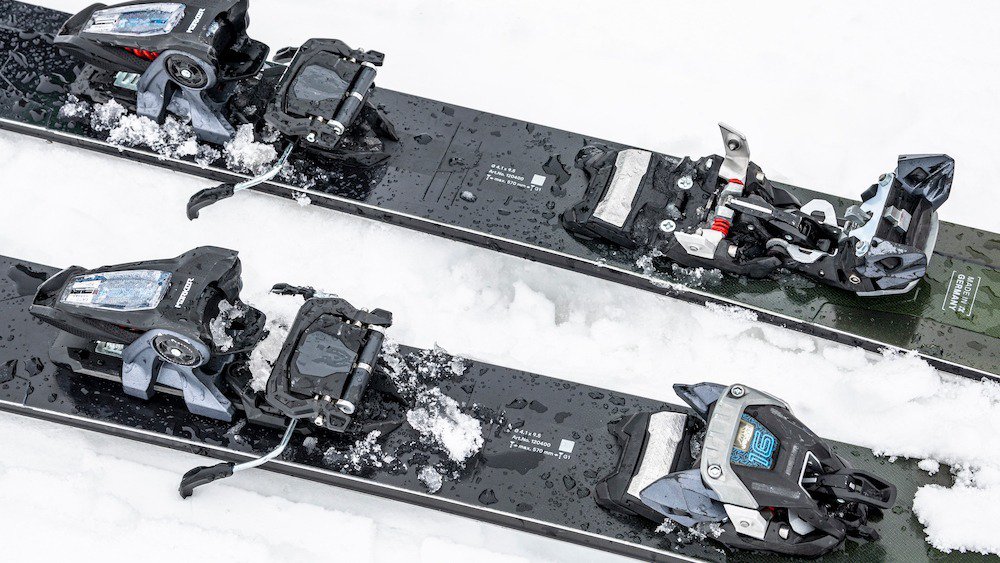
Marker worked on the Duke PT for about three years. Notably, it features the Inter Pivot Heel from Marker’s Jester, Griffon, and Duke bindings, which provides primo elastic travel and power transmission. Much like with the Shift, the heel piece remains in one place for climbing and descending (unlike the last major Marker binding innovation, the Kingpin). Skiers get one climbing aid at 10 degrees, same as the Shift.
For climbing, the alpine toe housing flips forward to reveal the tech pins. Marker says you either leave the toe flipped forward, useful for shorter tours, or remove it completely to save 250 grams per binding (one initial pro tip: don’t lose it!). The difference in toe placement, slightly forward to engage the pins and slightly back to step in for ski mode, allows for no moving parts. This is another similarity to the Shift. When you’re ready to descend, you re-engage the alpine toe piece, which auto-locks with a latch.
While the Duke PT stokes the touring binding fire, it also does a huge service to skiers. More than ever, folks are seeking one ski, one boot, and one binding to do it all, including take them into the backcountry with confidence.
Marker Duke PT: On Snow
First off: I was stoked when Salomon released the Shift. When Marker announced the Duke PT, I was intrigued but skeptical. The binding looked (and weighed in) beefier, with a potentially annoying removable toepiece. My experiences with the Shift had left me with two quick judgments of the Duke PT. One, there isn’t room in the market for this binding. And two, it would probably balance a few quirks with pretty good downhill performance…like the Shift.
After spending a full season on both bindings, I now sing a different tune. Bottom line: I’m a big fan of the Duke PT.
Going Up
Yes, the Duke is heavier than the Shift (and obviously most other non-frame touring bindings). But the point is: It tours. We’re said it before, and we’ll say it again. If you’re a gram-counter or a long, fast, ‘n light type, you already know this isn’t your scene. But if you’re a resort skier looking to dabble in touring and only own one setup—or a freeride skier who wants to maximize the descent once in a while (or always), you won’t mind the weight. More on that later.
I skinned the Duke PT on a variety of powder days and objective-based tours. The longest was a two-hour/2,000-vert ascent (skinning plus bootpacking) around Colorado’s Black Mountain outside Arapahoe Basin. My hips got used to the weight, and the binding skinned fine (it just sits there, right?) The climbing lever takes some getting used to—it will fight you at first. The toepiece is more challenging to step into than the Shift and some light/easy tech bindings like the ATK Freeraider 14. And on occasion, the bar under your boot that engages your brakes will stay upright when you try to click into downhill mode. It’s a quick fix, but a bit alarming at first.
All that to say: Some small quirks, yes. Dealbreakers? No.

Going Down
On the descent, the Duke feels just like a Jester Pro, which I skied for three seasons. It’s burly and powerful. It proved durable over the course of a season. And it inspires confidence when you’re hunting airs, hucking front flips (often unsuccessfully for me), or raging down big, steep lines.
I have eaten complete s*** on the Duke PT and always felt like it released when it should have (like, not all the time). I didn’t always feel that way with the Shift. Also, I haven’t encountered any quirks that influence your descent. It holds up as a rock-solid freeride binding for aggressive skiing. Case in point: I skied it in-bounds around 25 days this past season and have no complaints.
Downside
Yes—I have forgotten my toe piece at the bottom of a climb and been SOL at the top. Luckily it only happened once and it was a 20 minute climb. Be warned…this could be a day ruiner. But my take is that if you sign up for the Duke PT, you sign up to be responsible if you misplace or forget the toe piece. Mostly self-critiquing there.
Bottom Line
The Shift, especially when adjusted properly, does exactly what it says it will for, say, 90% of skiers. It’s generally best for people who overall put less torque on bindings on the way down (smoother skiing, smaller person, more conservative skiing, fewer airs, etc).
The Duke PT is the hybrid freeride binding tuned most for aggressive, expert downhill skiing. You pay a weight penalty, but (at least in my experience) it’s worth it to avoid some quirky performance issues and inspire maximum confidence for maximum charging.
Specs
Weight (grams per binding)
Shift (6-13): 860 g | Duke PT 12: 850 g without toepiece, 1090 g in downhill mode | Duke PT 16: 1,000 g without toepiece, 1,280 g in downhill mode.
Boot Compatibility
Shift: Salomon MNC technology, compatible with alpine boots, alpine touring soles (ISO 9523), and GripWalk.
Duke PT: Marker Sole.ID technology, compatible with alpine boots, alpine touring soles (ISO 9523), and GripWalk.
Uphill
Shift: Engage tech pins, stow brakes (step down with heel), lock toe lever (two settings).
Duke PT: Remove toepiece housing (or flip forward), engage tech pins, stow brakes (step down with heel), lock toe lever.
Downhill
Shift: Stow tech pins, flip heel into “ski” mode, step in.
Duke PT: Re-engage alpine housing, release brakes, step in.
Heel
Shift: Salomon Warden 13
Duke PT: Marker Griffon/Jester
Safety
Shift: Gliding AFD, elastic travel toe and heel, lateral and vertical release, DIN ISO certified release toe and heel.
Duke PT: Gliding AFD, elastic travel toe and heel, lateral and vertical release, DIN ISO certified release toe and heel.

