By Lily Krass
Ski commutes are more fun when you can wine, dine, and trip-plan.
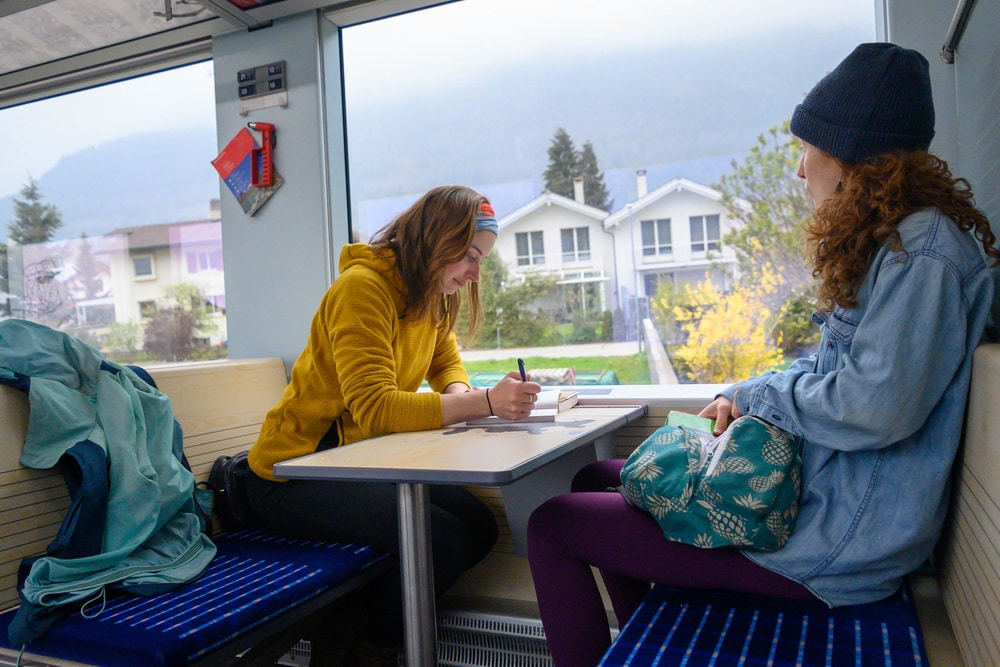
We’re whizzing through the Swiss countryside at 250 kilometers per hour, grazing on a spread of charcuterie and decadent Austrian pastries while looking over our maps for tomorrow’s objective. Yesterday we were scrambling up jagged, walled-in couloirs outside of Innsbruck. Tomorrow we’ll be climbing high into Italy’s Ortler Alps to ski between various rifugi (full-service mountain huts). We’ll attempt a few 3000-meter peaks along the way.
The train slows as we begin to snake through bright green valleys peppered with castles and ruins on our way up and over Bernina Pass. Noses (and cameras) are glued to the window, and it’s almost comical to realize that this, in fact, is a completely normal ski commute in Europe. Sure beats sitting bumper to bumper in I-70 traffic.
While planning a month-long ski trip to Europe, our group researched plenty of transportation options. After weighing our options with car rentals, bus schedules, and train passes, we decided to go all-in with rail travel. It’s not to say that train travel is a flawless alternative to other travel options. It can be hard to get to specific trailheads without a car and train routes can be overall a little pricier than a discount overnight bus. But if you do your homework and get familiar with the train routes, the idyllic (and yes, very cliche) fantasy of sprawling out on a high-speed train, winding through jagged mountain scenery in the company of pastries and a cappuccino is every bit as enjoyable as you might imagine.
“Noses (and cameras) are glued to the window, and it’s almost comical to realize that this, in fact, is a completely normal ski commute in Europe. Sure beats sitting bumper to bumper in I-70 traffic.”
To Ski Europe by Train, Do the Math
To train pass or not to train pass? That was the first question that popped up after we decided to commit to the train. We decided to go with a one-month unlimited Eurail Global Pass, which lets you travel wherever you want, whenever you want for an entire month. At first glance, $600 seemed a little steep, but calculating what our individual train tickets would cost for a month, it just about evened out. Plus, when the weather took a turn in Chamonix and high winds shut down all the lifts, we hopped on a train to Paris and spent the weekend soaking up impressionist art and snacking on ham-and-cheese crepes. Not a bad consolation.
While we definitely got our money’s worth with the one-month pass—we wrapped up the trip with 21 train rides—you can also purchase a 5-day unlimited pass for $250, which gives you five unlimited travel days within a month. It’s a good option that still allows some flexibility if you’re trying to ski at three or four places, and $50 per travel day is about half the price you would pay to travel to a different region on normal train tickets.
Two things to note: You have to purchase your Eurail pass in the states. Once you’re in Europe it’s no longer eligible for purchase, as it must be mailed to a U.S. address. You also have to make reservations ahead of time for some of the high-speed trains. If you do it online or at the train station, it’s half the price of the fee to buy a ticket on-board from the conductor.
Packing: Manage the Beast
Consolidate, consolidate, consolidate. Anyone who’s been on an international ski trip knows all too well the struggles of navigating public transportation with a gargantuan ski bag. If you can manage while staying under 50-pound airline limit, try to get down to two people per ski bag, especially if you’re travelling in a big group. When you’ve got five people all with their own ski bags, trying to get on a jam-packed regional train in the afternoon is about as easy as pushing your way through the lift line at A-Basin opening day—not to mention the glares you’ll get from impeccably manicured Italian businessmen at Milano Centrale, disgusted at the idea of sharing a cabin with anyone who’s not dressed head to toe in slim-fitting shades of designer black and grey.
If you can’t find space in the overhead compartment for your ski bag, we usually found luck in the bike car, where there’s more open space to stash oversize luggage. Once you’re on the move, the OBB Scotty app will be your new best friend while planning your routes. Plug in your destination and it comes up with all the possible bus and train routes, transfers included. The app even tells you which platform you’ll arrive at and which platform your next train leaves from, a huge help when you’ve got a three-minute transfer.
Check the Map
If you want to make skiing by train easy on yourself, do some research ahead of time to see where the train station is in each town. Sometimes the train can get you exactly where you want to go, but if you’re trying to ski in a more remote area, the train might not get you all the way. For instance, the Chamonix train station is smack dab in the center of town, so you could feasibly get off, shoulder your skis, and walk straight to the Aiguille du Midi.
Staying in Innsbruck gives you tons of options for skiing. The train drops you right in the city center, where if the sky is clear you’ll notice the Nordkette, a steep wall of snow-caked peaks almost 6,000 feet above the cobbled streets in the Old Town. Its a quick walk to the Hungerburg funicular which takes you up to the cable car that services the ski area. It’s entirely south facing, meaning if you roll into town at the right time of day and make a beeline for the tram, you could rip a few laps of smooth spring corn in the afternoon. Free ski buses run all day to neighboring resorts from the Innsbruck train station. Axamer Lizum, Schlick 2000, Kuhtai, Mutteralm, and the Stubai Glacier are all easy day trips, anywhere from 40 minutes to an hour and a half from town.
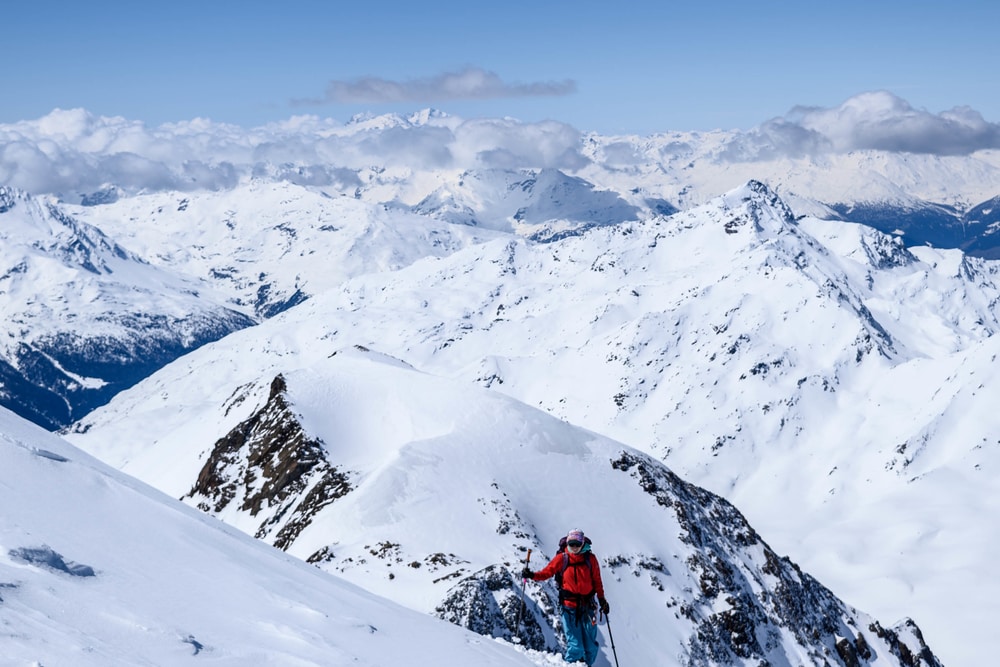
We spent six days in huts along the Ortler Route in Italy during the middle of our trip, and found it harder to access the trailhead via public transportation. The train station took us to the town of Tirano, about an hour from the trailhead, and we had to bus into Bormio before catching a taxi ride up the hillside. Not as straightforward as hopping off the train in Chamonix and walking across the street to the lift, but if you have the time and tolerance for a little improvising, you can get yourself (and your skis) just about anywhere.
No Time Lost
My favorite part about Europe’s rail system is that even when you’re on the train, it never feels like wasted time. Many of the high-speed trains have WiFi, so you can use a three-hour train ride for route planning, work emails (if you must), photo editing, and even hotel reservations if you like to fly by the seat of your pants. Offerings at the dining car are usually expensive and uninspiring, so I like to instigate an elaborate train picnic, perusing the aisles of local grocery stores for the stinkiest cheeses, cured meats, fresh fruit, a warm baguette, and a $4 bottle of Prosecco before hopping on board.
Life is too short not to indulge a little every once in a while.
Read more from the Lift Line: You can also find epic hut skiing in Austria


